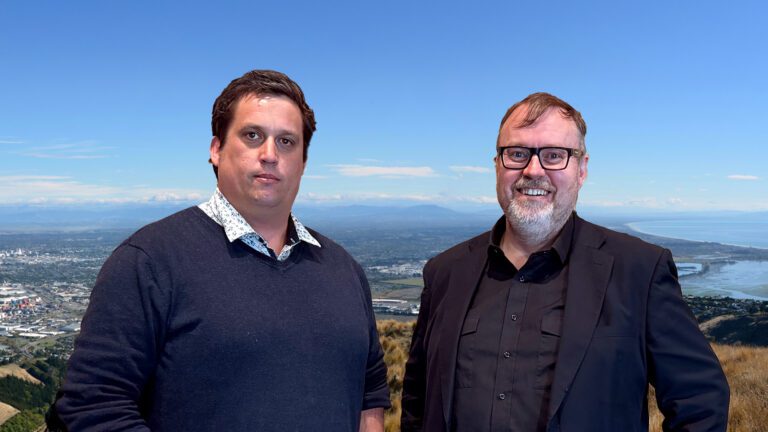
Join Paul Spain as he chats with Scott Spooner (SPS Automation). Discover the fascinating world of bespoke robotics, from AI-powered agricultural drones combating wilding pines to spectacular drone light shows. Scott shares SPS’s journey from garage startup to cutting-edge innovations, including hybrid-powered heavy-lift drones, swarm technology, and navigating New Zealand’s flexible regulatory landscape. If you’re passionate about tech, aviation, and the future of autonomous vehicles, then listen in!

Apple Podcasts Spotify RSS Feed

Special thanks to our show partners: One NZ, 2degrees, Spark NZ, HP, Workday and Gorilla Technology.

Episode Transcript (computer-generated)

Paul Spain:
Greetings and welcome along to the New Zealand Tech Podcast. I’m your host, Paul Spain. And recently while attending the New Zealand Aerospace Summit in Christchurch, I had the privilege to sit down with Scott Spooner, founder of SPS Automation. In this episode we’re going to delve into the world of bespoke robotics and drone technologies. Absolutely fascinating discussion about this Christchurch based company that’s been working in everything from agricultural drones and robotics to drones that work together to produce light shows. The New Zealand Tech Podcast is proudly brought to you in conjunction with our show partners which includes One NZ Spark, 2degrees, Workday, HP and Gorilla Technology. So let’s jump in.

Paul Spain:
Okay, we’re here at New Zealand Aerospace Summit with Scott Spooner from SPS Automation. How are you, Scott?

Scott Spooner:
Good. It’s been a great first day at the summit. Some great technology and great talks today and another exciting day tomorrow.

Paul Spain:
Yeah, looking forward to it. Now most of our listeners probably don’t know what SPS does, so maybe you can give us a sort of high.

Scott Spooner:
Level overview, a bit of a rundown. Yeah. So SPS is a bespoke robotics company specialising in the development of novel aviation products, drones, big drones, small drones and all the kind of smarts around how they operate, whether that be in swarm or beyond visual line of sight, or development of, you know, agricultural or drone light show systems.

Paul Spain:
There’s a fair bit of variety in there.

Scott Spooner:
I mean the size of the aircraft changes, but a lot of the smarts, you know, is across the different platforms. It’s quite funny actually. Some of the smaller drones that we’ve produced have such advanced avionics in them now and like things like dissimilar redundancy across primary flight sensors. We’re actually rolling that up to our larger drones. So it’s pretty interesting.

Paul Spain:
And how long have you been operating?

Scott Spooner:
So SPS Automation has been around for about six years. We started in my garage, just me building drones and developing. We started with a big, an aircraft that we I built called Big Yellow. And we sort of have a bit of a passion around controlling some of the invasive plants in New Zealand, especially wilding pines. For those who don’t know, wilding pines are rampant. Pine trees that grow all over the countryside, they suck up all the water out of the soil. They basically kill off all of our native plants and kill the land really. So we wanted to come up with an idea of how to solve this problem of wilding pines, but not, I mean we already spend a lot, the government spends a lot on helicopter broadcast spraying and ground crews coming in and chopping them down.

Scott Spooner:
But there’s a real shortfall where you can’t really access, you know, by, by foot, but it might not be financially viable from a helicopter. So getting in there, we thought drone technology would be the way and we started with that and then we’ve been building machines for that for some time. We’ve branched out into larger spray machines for broad acre release spraying, developed AI systems for recognizing recognition of different plant species, calculating the size of different plants so that we can apply targeted chemical doses. But from that we sort of grew and developed a whole variety of different types of aircraft system and do a lot of contract R&D for the greater aerospace community.

Paul Spain:
Right. And how big’s your team now, Scott?

Scott Spooner:
We have about 17 specialist engineers. We’re based in central Christchurch and we also have a production facility in Timaru. So we sort of dream up the craziness here and then we send the designs and the build manuals down to Timaru to produce, be produced, produce in a very controlled environment.

Paul Spain:
Now there’s been, you know, companies sort of building and developing drones in New Zealand over, you know, quite a period. I remember aeronavics doing, you know, crowdfunding campaign maybe that was, I don’t know, a decade ago. How has this sort of space changed and evolved from the time you started to now? How much has the technology and the ability to kind of, I guess, leverage off the shelf sort, sort of pieces that mean you’re not having to build everything from scratch, whether that’s hardware or software and so on.

Scott Spooner:
I mean, that’s interesting that you mentioned aeronavics. So prior to SPS Automation, I was actually the chief engineer for Aeronavix for five years. And then when I left, we started SPS Automation. And since then aeronavics has actually come together with SPS Automation and we are just one company. So aeronavics is the product facility that I was talking about in Timaru, whereas SPS Automation is R and D. So moving on to your sort of next point around, having to design everything ourselves versus being able to use off the shelf stuff. I still have a preference for designing everything myself. And it sort of is represented in our aircraft that we develop.

Scott Spooner:
Like, it was difficult in the early days where we had to design a lot of different systems for our aircraft. But the methodology we use around our sort of design aspect and engineering design is to make everything modular. So we design something for one aircraft, we roll that technology into the next aircraft, and we’re sort of at a stage now where we can look at everything we manufacture and pull all the different modules that we’ve already designed and just left with a small part that we have to do? So it was difficult in the start, but having control over how everything works, especially from a quality point of view, is really important.

Paul Spain:
Yeah, okay. And what are the bits and pieces, you know, what are the bits and pieces of the business that sort of really stand out commercially in terms of that have, you know, that have been working, working well for you? Is the Wilding Pines sort of part? Is that quite a key part or is that still a journey to, you know, to make that work commercially?

Scott Spooner:
I mean, it’s been a balance between our contract R and D work and acting as a R and D enabler for other, you know, for other technology developers for the universities. You know, they kind of struggle in some areas where they need something really specific made and we can help with that and we sort of feed that back into our R and D projects. The wilding pines we’ve done had a great success with some of the trials that we’ve done. So we recently did a trial down in Central Otago. It was about 500 hectares with a sparsity of trees of about one per hectare. So really spread out. It’s not really suitable for ground crews to. There’s a lot of walking involved in that.

Paul Spain:
Yeah, for sure.

Scott Spooner:
But really not really great for helicopters either because there’s a lot of mucking around. Evolved so normally it would take several weeks for a ground clue to clear that area. We came in, spent two and a half days flying our smaller drone, the AC16, applying chemical in quite strong winds as well, dealing with that displacement of the chemical. But we were able to get through. Yeah, two and a half days we were able to smash that job out. We sprayed every tree that they had.

Paul Spain:
What sort of number of trees are we talking about?

Scott Spooner:
Between sort of 350, 450 ish.

Paul Spain:
Yeah.

Scott Spooner:
Okay. In some really complex locations. Overhanging cliff faces where you’d never get a helicopter or absell or anyway. But we sent the drone in and did the spraying and I mean there’s one side to a put the spray onto or the chemical onto a plant. But we actually went back two months later and to verify our spray spray systems and verify that we actually got what we wanted because it was pretty windy and we got 100% kill rate across every single plant we sprayed, which is really incredible and a great sort of result for drone technology. Working in whitings is quite difficult with spray application or chemical application from drones because different operators have different results Bolts because they have different experience levels with how their systems work. And there’s a lot of misinformation around whether drones actually do work for doing some of these spraying operations. So it was great to see that we could go in and get a perfect kill rate on these trees.

Paul Spain:
Well done.

Scott Spooner:
That’s.

Paul Spain:
That’s really cool. Now talk about the, the capabilities and you know, the size and scale of the. The drones that you built.

Scott Spooner:
So we’ve done small drones, so sub kilo or about one kilo, but with all the smarts and bells and whistles to operate in Swarms of up to 3,000 and, you know, in unison. But then our BFD aircraft, or the BFD 70 aircraft, that’s a four and a half meter from tip to tip multi rotor with a maximum takeoff weight of around 160 kilos, carries a 50 kilo payload, and that has a flight time of around two hours at fully loaded weight. If we reduce that payload, say, down to 25 kilos, we get about four to five hours, and we can get right up to about 10 to 12 hours if we’re just carrying sort of five to 10 kilos. So depending on what you want to do with these aircraft, you can sort of optimise their use case. So if you’re spraying and you just want to pump heaps of chemical through, load it up. Shorter flights, but you can still. Two hours is still a long time to fly.

Paul Spain:
What are they powered by?

Scott Spooner:
So all of our bigger aircraft are hybrid, which means that they run. They have an onboard internal combustion engine coupled to an alternator that generates electricity to power a traditional electric propulsion system like your normal drones. But instead of having a battery, I got a big generator on board, put fuel in. As long as there’s fuel in the aircraft, that machine’s in the air and working.

Paul Spain:
Yep. And do you have some sort of battery backup? If a.

Scott Spooner:
So we definitely have a battery backup. The aircraft usually gets around, depending on which model, between 5 to 10 minutes of backup time. Should there be an issue with the engine if you’re just say, for example, running low on fuel? The aircraft knows everything about what’s going on with itself, so it’ll come back automatically if it’s running on fuel or if it runs out of chemical. But in the event that there was some issue, it gets about 10 minutes, which is actually longer than most agricultural drones will fly anyway, so you can still transit pretty far. In the worst case scenario, the aircraft will actually look for a flat area itself and place itself down. So it’s got a lot of AI on board, smarts, guidance systems that handle all the kind of difficult nuances of operating an aircraft.

Paul Spain:
Right. What sort of communications and, you know, tech is built in in terms of, you know, what can happen on the drone versus, you know, are they communicating up to the cloud for certain things? How does that fit together?

Scott Spooner:
So with the BFD70, we wanted to design it around teleoperation, which means aircraft in the wilderness doing spray operations by itself. And instead of having a specialist pilot on site for one per aircraft, having a centre where expert pilots can operate multiple drones simultaneously. Anywhere in the country. That posed some technological challenges for us. But because most drones, as you know, you’ve got a controller and the drone’s over there somewhere and you’re dealing with flying it manually or watching it manually. So we still have that sort of controller point to point link, but we also included a 4G 5G cellular modem so it can work on the cellular network as well as the sort of ISM band which is your local link. But the big game changer for us is Starlink. We have a Starlink dish on board which is able to beam all the data that aircraft is capturing directly out to anywhere in the country where you can actually operate these aircraft from live video feed.

Scott Spooner:
The machine has forward and downward facing stereoscopic machine vision cameras so it can do some of the heavy lifting. Regarding is there something in the way? Is, you know, do I need to detect something? Am I recognizing a particular type of plant? So most of these systems are autonomous, but we do now have the ability to have somebody operating this aircraft that can make the correct decision when the system deviates from the predetermined flight plan, which is really what pilots do with drones these days. There’s no Top Gun anymore, no stick, you know, hold onto your gloves, this thing’s going. It’s all press the go button and watch to verify that nothing is deviated from what you’re trying to do. And then in the event that something does go wrong, making the correct decision based on the ground and air risk of what you’re doing. Right.

Paul Spain:
And I mean, how hard are the technical problems that you work to solve, Right? Cause I guess you’re on a journey with these things. And ultimately we head towards a world where it’s completely autonomous.

Scott Spooner:
Hard. No. So I mean we try to develop everything in house. We’ve been doing this a long time, you know, from the early days working at aeronavics, learning about avionics and flight systems and flight computers through to developing our own code bases to manage some of the communication systems and the different C2 links or radio networks that we use. I mean, the reality is that me personally, it’s way too stressful for me, but I’m backed by an incredibly smart engineering team. We recruit a lot out of Canterbury and New Zealand engineers. They have a sort of nels around them where they can actually think logically and come up with some really great stuff. So it’s, it’s made a lot easier being backed by great people who are also enthusiastic about, around the aerospace and what we’re actually and believe in what we’re doing.

Scott Spooner:
So hard, but great.

Paul Spain:
Yeah, yeah. And how, how you, how you funded, how you work on that sort of basis at this point.

Scott Spooner:
So we have private shareholders that fund us. So based in Timaru, they provide us with a lot of opportunities to develop these systems. And we also offset our development costs of our internal aircraft by doing contract R and D work for external parties. So, you know, a university or a private company will come to us and get us to develop something and we use that to feed back into to our systems as well.

Paul Spain:
Yep. Now, you mentioned the idea of sort of swarms. We’ve had a chat on a previous episode with Isaac from drone shows, and I think you’re probably developing the technology for them. So how’s that journey going to be able to, you know, make all those sort of things work?

Scott Spooner:
Yeah, it’s going really well, actually. I mean, I was sitting here today in the conference and my team was out performing a drone show at our test site today. So developing swarm technology has been fun. Isaac’s drone show system is cutting edge. And I mean, I get to say that because I know what’s under the hood. Having quite a heavy involvement in some of the technology that we put into it. It’s an exciting sort of place to be. You know, you start working with one or two or three, four drones, but when you’ve got 50 and you’re trying to manage a fleet as they sort of go up in numbers, you actually have to rely a lot more on the technology to just manage everything and then make sort of larger global decisions of how to operate them.

Paul Spain:
Yep. And how does that work, you know, from say, a positioning perspective, because you can’t necessarily use GPS’s if you’ve got a lot of drones flying kind of near to each other and so on.

Scott Spooner:
Or we definitely, definitely use gps.

Paul Spain:
Okay, so it’s all about gps because I remember what was he mentioning?

Scott Spooner:
Redundancy for GPS or local positioning system.

Paul Spain:
Yeah, probably something local, I think, previously.

Scott Spooner:
So the drone survey system that we’ve been developing, I mean, this is not our technology. We’re the R and D developer of the technology for drone shows. They use dual RTK gps. So it runs two independent GPS systems which are RTK to give us heading. And we also have an internal secondary localization system that allows for redundancy. If gps, say, for example, all the satellites turn off, who knows, you know, that kind of works in a reverse GPS way. So instead of the satellites out radio frequencies that the aircraft interprets to calculate its Position, you place out ground radio beacons essentially, and the aircraft can triangulate themselves within the coverage area. So things like that, which is dissimilar redundancy across primary flight sensors.

Scott Spooner:
So locational information GPS is one type of technology and then it switches to the backup system, which works on an entirely different methodology. So if something affects the first, it’s unlikely to affect the second.

Paul Spain:
Yeah, okay, that’s pretty cool. You know, what does the future look like for you? If you were to look sort of five or 10 years out, where are you thinking you’d like to be delivering.

Scott Spooner:
Really great aircraft all over the world? You know, we have a pretty solid roadmap for our internal development. We have our BFD70. We’re starting to look at the BFD Pro, which is the next sort of variant of it, which is a bit bigger with a bigger payload, and then sort of down the line incorporating a whole variety of, I guess an ecosystem of autonomous vehicles technology for the betterment of New Zealand. Right through to like herbicide alternative, invasive plant control. So how can we not put any chemical into the environment? What about organic farms? Like, if we’ve got to do work near, near that, how do you control that? And then big aircraft, we’ve got some big stuff planned on the way. We were sort of looking at 250 kg plus payloads.

Paul Spain:
People?

Scott Spooner:
No people. I mean, helicopters have been around for a long time. Planes have been around for a long time. And there is a sort of space for personal air vehicles and air taxis and all of that kind of stuff. And as exciting as that is, I’m more focused on developing autonomous vehicles to handle jobs in areas where you don’t want to put people to make it easier and safer for agriculture and stuff in New Zealand like that.

Paul Spain:
Yep. And can you speak to the regulatory environment? You know, how’s that been for you? And you know, what’s the current sort of status there in terms of where you want to go?

Scott Spooner:
So the 102 system, the Civil Aviation Rules Part 102 system, it’s been hard, but really good. We wanted to do some crazy stuff. We went to the CA and said, Look, I want to fly 160 kilogram drone in swarms beyond visual line of sight, teleoperated in the mountains, you know, upside down, doing flips, flashing lights at night, who knows, when we went to them and said all the sort of crazy stuff that we wanted to do, they were kind of like, oh. But we sat down and worked out how to go through this and you know, at the start they didn’t know like we didn’t have a written down this is how to do it. But we worked with them and actually came up with a pathway that allowed us to get to where we need to go. Since we started that journey, we’ve worked out how to set up maintenance organizations and training around our maintenance training around our aircraft. We’ve set up two experimental aircraft bubbles or geographic locations where we can perform complex operations with experimental aircraft in controlled environments. Has been approved by the CAA without sort of restriction.

Scott Spooner:
And that is really, really incredible. And there’s not anywhere else in the world that I think that we would be so lucky to get away with what we’re of doing here. And it’s not even getting away.

Paul Spain:
It’s because what you’re doing is safe. It’s just that they’re flexible enough that you can.

Scott Spooner:
The sort of, the flexibility, you know in New Zealand you say, I think it was in a presentation earlier today, I want to build a flying T Rex with rockets and you know that goes into space and changes color or something. And you can do that if you can prove the safety case. Yeah, the flexibility is very enabling in New Zealand. So it’s a very, very powerful system. But there is some complexity in getting to that point because nothing is prescriptive. There’s no written way you want to do that. This is how you have to do it. You have to come up and tell them how you’re going to do it.

Scott Spooner:
And quite often, I mean even especially for us, like I spent a huge amount of work learning about different SoR of risk analysis systems, the Sora 2.5 system, which is specific operational risk assessment, going through that, trying to work out how to adapt that for a non specific aircraft. And it’s a challenge. I found it mediumly fun, medium as in I actually got what I wanted at the end. But yeah, hard work, mentally tough.

Paul Spain:
Yeah, yeah. Overall we’re in a good state but there’s probably, there’s more work to, more work and more, more iteration to do.

Scott Spooner:
I think, I think we’re in a great state. I think ultimately adding some standards around some of the things like some of the training syllabuses around what constitutes it, you know, training for a drone pilot. What standard do they actually need to have? What knowledge do they need to have? How do you get somebody to do maintenance on your aircraft? What standard do they have that you know that if you take your aircraft to that person to perform maintenance for you that they’re going to do a good job and your aircraft is going to be airworthy afterwards. I mean, this has been around in crewed aviation for years, but in the unmanned scene, just the way it is, it’s all a bit gray, so bringing some standards in around training, I think would be quite good. And airworthiness standards.

Paul Spain:
Yep, yep. Oh, that’s really interesting. Anything else you wanted to add, Scott?

Scott Spooner:
We’re in Christchurch. SPS Automation. If you’ve got a. A crazy idea, it doesn’t matter whether it flies or rolls or, I don’t know, dances in the street, let us know and we’ll see if we can help.

Paul Spain:
Fantastic. All right. Really appreciate your time. And all the best for the rest of the New Zealand Aerospace summit.

Scott Spooner:
Yeah. Thank you very much.

Paul Spain:
All right. Cheers.

Scott Spooner:
Cheers.

Paul Spain:
Well, thanks for joining us on this episode of the New Zealand Tech Podcast. A big thank you, of course, to our show partners, to One NZ, Spark, 2degrees, Workday, HP and Gorilla Technology. All right, I’ll catch you on the next episode. This is Paul Spain signing out. Cheers.