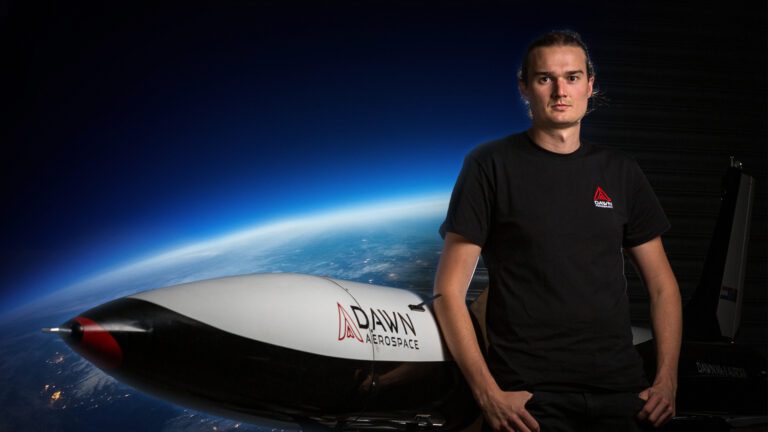
Host Paul Spain reconnects with Stefan Powell, co-founder and CEO of Dawn Aerospace, to discuss the rapid evolution of New Zealand’s space sector. Stefan shares the highs and lows of steering an aerospace startup through rapid growth, the realities of innovating in both aircraft and space tech, and what it’s taken to build customer trust in a high-stakes industry. Explore Dawn Aerospace’s advances in reusable space planes and green in-space propulsion, the company’s international growth, and how their technology is powering global space missions and research.
Special thanks to our show partners: One NZ, 2degrees, Spark NZ, HP, Workday and Gorilla Technology.
Episode Transcript (computer-generated)
Paul Spain:
The New Zealand Tech Podcast brought to you by Guerrilla Technology Proactive and Strateg. Greetings and welcome along to the New Zealand Tech Podcast. I’m your host Paul Spain and this week I’m attending the New Zealand Aerospace Summit in Christchurch and in this pre recorded episode I visit the Canterbury HQ of Dawn Aerospace to talk with Stefan Powell, their co founder and Chief executive. Dawn Aerospace is a pioneering space transportation company based in New Zealand and the Netherlands. Stefan is a visionary leader driving innovation at the intersection of aerospace engineering and sustainability. Under his leadership, Dawn Aerospace has developed cutting edge green propulsion systems for satellites and is building reusable space planes designed to revolutionise access to space. Stefan’s journey began with a bold mission to make space more accessible and sustainable. Since founding Dawn Aerospace in 2017 along with a team of fellow engineers, he has helped grow the company to over 120 staff across four countries with propulsion systems now flying on rockets such as Falcon 9, Vega and Soyuz.
Paul Spain:
From end of last year, on the 57th flight of the Aurora space plane, they reached supersonic speeds Mach 1.12 and climbed to an impressive 82,500ft or 25.1 kilometers. In doing so, Aurora set a record for the fastest climb from Runway to above 20 kilometers in altitude, breaking a nearly 50 year old record previously held by the modified F15 Streak Eagle. In June 2025, Dawn Aerospace announced the very first sale of their Aurora space plane. The this first one will go to Oklahoma Space Industry Development Authority O CEDA with delivery scheduled for 2027. As of this episode, Dawn Aerospace has 167 thrusters that have been launched to orbit across 38 satellites. Of course a big thank you to our show partners to One NZ,
Paul Spain:
2degrees, Spark, Gorilla Technology, Workday and HP. Stefan Powell, great to have you back on the podcast. How’s things?
Stefan Powell:
Yeah, good, thanks Paul.
Paul Spain:
Now, about four years since we last podcasted, which in the life of Dawn Aerospace is a pretty big chunk of time.
Stefan Powell:
Yeah, yeah, it sure is. Four years. I mean it goes by quick though. I think like we were just flying an aircraft for the first time back then or the first ground up, build and yeah, like last year we’ve flown supersonic and sold an aircraft and flown a whole bunch of customers. So yeah, it’s, things are really moving.
Paul Spain:
It’s pretty incredible. You know what, you know, you’ve just mentioned, you know, some, some of the highlights how, how hard is this, this window of time, you know, been there have been, you know, a lot of, you know, through, through parts of COVID there and you know, just an incredible pace of growth for you.
Stefan Powell:
Yeah, yeah. Oh, and, and it’s, it’s been, to excuse the pun, it’s been a lot of ups and downs. So like, lots of successes of course, but lots of like hard lessons as well and some restructuring of bring more stuff to like to consolidate some of our projects. But yeah, lots of success on both sides of the company on the space plane side as well as the in space propulsion side. It’s kind of been, we’ve been a very commercially driven company, I would say, in that we’ve really followed what customers have required of us. And that’s meant lots of small changes, if you like, but the kind of like the core underlying principles of how we operate and the underpinning ideas of why we build this sort of technology have all remained really, really true. So for example, in that four years, the world’s gone from having about 3,000 operational satellites to about 12,000 today. So that, that hockey stick has really, really started to take off.
Stefan Powell:
You know, it was, the world was sitting at about one and a half thousand operational satellites basically since, since the mid-80s. So that’s really just gone gangbusters in the last few years. And the other trend that’s had a massive change, you know, since dawn got started in 2018 is the spending on hypersonics, or rather just really high speed flight research. You know, when we started that was about US$200 million a year. Now it’s about 7 billion. So in four years ago it was only just getting up around one and a half billion sort of range. So yeah, that’s really quite literally taking off as well.
Paul Spain:
Yeah, yeah, that’s really exciting.
Paul Spain:
So I guess, you know, maybe break.
Paul Spain:
Down the two sides of the business and you know, how that’s actually gone, you know, compared to your initial plans and goals.
Stefan Powell:
Yeah, well, before I go into like breaking them down, the thing that underpins them both is the idea of reusability kind of being the, the be all and end all of space technology. Rockets as well as satellites are like the most unreusable vehicles humanity has ever consistently built. Spacecraft basically never get refueled. Even the best rockets today only get refueled maybe 20 times if you’re lucky. That’s kind of the bleeding edge. And even that’s only been established in the last few years.
Paul Spain:
And that’s pretty different to a typical aircraft, right?
Stefan Powell:
Yeah, exactly. Aircraft are actually at the very extreme end of the scale where they get refueled something like 10,000 times in their lifet. Even a car only gets refueled about 500 times. So aircraft are really, it’s crazy how much utility we get out of aircraft, even compared to, even compared to cars. But you know, spacecraft and rockets are just frankly pretty bad. And that’s why space is so hard. That’s why, you know, everything has to be first time. Right.
Stefan Powell:
Because you’re not going to get a chance to refuel it. Yeah, it just makes everything way, way more stressful because you’re not on this flywheel, which is the flywheel of getting to scalability. It seems quite logically obvious when you say it like this, but you won’t get to scalability if you don’t have reusability because it’s just way too expensive to do it. You know, space is a tiny industry because it’s not reusable yet. But you won’t get to reusability if you don’t have reliability. You know, if you, if your thing is going to fail 1% of the time, then you’re probably not going to reuse it more than 100 times. You know, like statistically speaking, it’ll be broken before then. Your rocket will have blown up or whatever.
Stefan Powell:
So this whole, like, getting to scalability is the goal. You know, we know there’s, there’s already tens of thousands of satellites. There’s going to be hundreds of thousands of satellites, and it’s probably only a matter of time before it’s, you know, significantly more than that. So if scalability is the goal, we actually have to start at reliability. So reliability, then we get to scalability, then we get reusability. And the awesome thing is that we’ve really started discovering in the context of spacecraft, but is already obvious for aircraft, is that once you get to scale, you start getting statistically significant data on how things operate. You know, like, oh, I used it once, it broke in this way, I will fix it. Oh, I’ve used it 100 times.
Stefan Powell:
I now start to understand a thing called a bathtub curve of how things break. And by virtue of that knowledge, I can now make them even more reliable, which makes them even More scalable, which makes them even more reusable and even more scalable. And you know, this is a flywheel that spins faster and faster. So this is a principle that we apply on both the in space propulsion side of the business where we’re building propulsion systems for satellites. You know, it allows them to move around once they’re already on orbit as well as our space planes, which are, you know, very clearly just a reusable way, you know, a way of getting the performance of a rocket into something that’s truly, you know, operates like an aircraft.
Paul Spain:
Yeah, yeah.
Paul Spain:
For those that don’t know, maybe, you.
Paul Spain:
Know, walk us through how you got your first, you know, pieces of business, right? Because when you, you’re not proven, you know, you’ve got to get those initial run runs on the board and obviously now you’ve got a lot of runs on the board. But how did you get build that confidence initially with, with customers?
Stefan Powell:
Yeah, it’s a good question because like, honestly that’s the hardest thing about aerospace businesses. Like actually the sometimes the technology is, it’s quite logically obvious, like oh yeah, we should just have aircraft, you know, aircraft that can. Great idea. How do you actually get there is mostly a commercial question. So that was a big part of the reason why we started in satellite propulsion. You know, we had this dream of building a fully integrated space transportation network of going from earth to space, you know, that’s the space plane and then from space, you know, to anywhere else that satellite propulsion. The satellite propulsion problem at the time was mostly a problem of using really toxic chemicals in space. And so we could reinvent satellite propulsion using non toxic chemicals that were going to be much more scalable, much more friendly to use and by virtue of those of that be much lower cost.
Stefan Powell:
So. But why would a customer buy this? Well, it has to be and take the risk of a new technology, a new company putting a pretty complex piece of technology at the center of their product. Like that sounds like a pretty risky idea. Ultimately you have to be very convincing that A, you can do it and B, it’s worth doing. So the is it worth doing? Like the technology has to be a pretty significant leap forward. It can’t just be like a small iteration. There needs to be a really, really good economic reason for them to do it. So thankfully the technology that we chose, nitrous oxide and propylene based propulsion is very high performance.
Stefan Powell:
It’s really dramatically cheaper. And so this was convincing enough for the customer to want to peg their long term vision to using these Propellants because that was attractive for them. They were also a relatively a customer with a pretty high risk tolerance themselves. They were a startup company, they needed an edge to be able to perform in the market as well. And we were able to tie that together with some European Space Agency funding to help, you know, make this more commercially attractive. So that was, you know, also a great reason for us to be operational in Europe at the time. You know, actually all five of the founders are European citizens as well. So like we have a strong European presence.
Stefan Powell:
You know, four of the five founders went to Delft University of Technology. So Europe has always played a very big role in the dawn story. And even today it’s About Europe is 70% of the, the in space propulsion business is European based. So yeah, that early traction was really being convincing enough in the technology being convincing that we were the people to actually be able to do it and having a bit of help from government as well to get it all going.
Paul Spain:
Yeah, that’s fantastic. Now, looking at the European market versus US and other parts of the world, how helpful has it been that, you know, you’re European citizens and that you’ve got, you know, I guess that split between, you know, Christchurch and Delft in the Netherlands.
Stefan Powell:
Oh, it’s absolutely a double edged sword. I’ll be the first to admit that, like it’s, it’s been amazing in the sense that we’ve been able to draw on the strengths of both, you know, I would say countries, but Europe’s much more than a country. Of course. You know, New Zealand, especially in terms of the space plan, has a lot of advantage in terms of like geography and access to airspace. And we have a regulator that, that’s very forward leaning and you can literally call up CIA and have a discussion with them. We work very, very closely with them to do very revolutionary work in that field that would be super hard to do in Europe. But in terms of having real commercial traction, there just aren’t many satellite builders in New Zealand. There’s not many people who are going to buy our thrusters.
Stefan Powell:
So that’s very, very challenging. Europe just has such a wealth of knowledge in this field. They have such a depth, like a commercial depth to them. There’s a lot of stuff going on there. So that, you know, Europe has been the commercial underpinning of the company for the longest time and that extends through to government support as well. That they have, they have a vision for how space should be done. For all their critics of their launcher program, they are actually very on top of like some particular fields, for example, space tugs. Europe has been way ahead of this game.
Stefan Powell:
This is essentially a class of satellite designed to take many, many other small satellites with it and convert a SpaceX style bus transportation to space and convert that into a dedicated service that many smaller satellites can use. Europe’s been doing this for years now and been doing a really great job of it. Capturing a huge amount of market and there’s only US players just kind of catching up to that now. So they’re actually on the bleeding edge of a bunch of, a bunch of things. So yeah, for dawn to be able to be a big part of some, some of these, these sort of like macro tailwinds has been really important. And now there’s a big defense macro tailwind in Europe as well with NATO spending going from 2.5% of GDP to 5% of GDP. You know the, the German federal defense budget is going to be something like 25% is going to be defense spending. So there’s, there’s a huge amount ramping up and a lot of that is going straight into space technology, communications and earth observation and those sorts of things that are really critical for European security.
Paul Spain:
And how competitive is the European market? How do you establish yourself and keep winning new deals in that market?
Stefan Powell:
It’s really dominated by the big players in Europe. There’s not a lot of really high tech startups in Europe. There’s, you know, the big dogs really dominate the Airbuses and the Talus and Safran and those ones which is a little bit different to in the States where there are those bigger players for sure. But there’s also quite a healthy number of smaller startups. So as a aerospace startup in Europe, we were quite early and we’re quite well developed now. So we’re able to have quite a significant role in the European startup mix, I suppose.
Paul Spain:
And what about the US market? What does that look like for Dawn.
Stefan Powell:
Aerospace really growing a lot. Like, you know, we recently signed this $17 million US dollar deal to provide a space plane to the state of Oklahoma. So that’s for sure a big part of our growth story is going to be in the us There is just a lot of spending in space happening there. So yeah, I mean I would say something like 80% of the world’s, you know, the total addressable market for space technology is in the States. So there’s no way to be a big relevant space company without operating there.
Paul Spain:
Yeah. So walk us through that deal with Oklahoma and how that’s, you know, come about and Ultimately what it’s going to look like because I mean this is, this is a huge deal for Dawn Aerospace, but. But also for them, right?
Stefan Powell:
Yeah, absolutely. I mean they’ve been, they’ve had the spaceport for near on 20 years now. We’ve been talking to them for about the last two and a half years. The whole idea of bringing a space plane to Oklahoma is not even like we’re not even the first to do that. There was, there were companies before us that, that had intended to do this and weren’t able to for whatever reason. But the whole point, like Oklahoma’s whole interest in this is all the secondary effects of having space capability. Like ultimately the reason that they have a spaceport there is to attract people to state to, you know, do, to participate in the space economy. Now they realized if they actually buy a space faring capability, you know, they buy a space plane, you know, they already spent hundreds of millions of dollars on a spaceport.
Stefan Powell:
If they spend tens of millions of dollars on a space plane, then they’ll actually bring the people that willing to use a plane rather than operate a plane. For example, a biomedical researcher might want to do some experiments on protein growth and microgravity to advance liver research. This person has specific budgets and goals in life sciences, not in owning aircraft. This person doesn’t want to own an aircraft. They want to buy a small slice of time on a space plane to be able to conduct their experiment. The same is true in the semiconductor industry where they want to grow hyper pure silicon crystals in microgravity. So the state of Oklahoma has talked to all of their key stakeholders, the aerospace industry, the silicon industry, the life sciences, the universities, the atmospheric researchers, the everyone and kind of got them to buy in on this idea that yeah, having a space plane would be a great thing. This is something that they would actually use.
Stefan Powell:
And the state is willing to take the risk to make that investment, get the capability there and they will reap the primarily the secondary benefits. You know, it’s the like yes, they’ll make money on the plane itself, but they’ll really make money on making Oklahoma a premier space state. You know, this is going to really put them on the map in terms of having unequaled access to suborbital microgravity.
Paul Spain:
What’s the competition look like for Oklahoma? How many other states are space faring at the moment?
Stefan Powell:
Well, it’s pretty much only the coasts in a big way. It’s basically California with Vandenberg. Florida of course with where, with the Cape. Virginia is where rocket Lab operates out of. And then there’s some small amount in Texas as well, but otherwise not a whole lot. So especially in the, in the interior of the country, you know, there’s, there’s some other spaceports, like Spaceport America, you know, at White Sands Missile Range. But yeah, there’s definitely a paucity of it. But there is a lot of aerospace industry there, especially in, in Oklahoma and Kansas and northern Texas or around that whole area that there’s like a very vibrant aircraft community.
Stefan Powell:
I think by serial number, something like a third of all aircraft in the states are produced in Wichita, Kansas, which is like only a few. Yeah, only a few hundred Ks north.
Paul Spain:
Wow.
Stefan Powell:
So plenty of expertise there. Plenty of, you know, demand for this sort of work.
Paul Spain:
Walk us through a little bit around the work that you’ve got to do between now and 2027 to make that actually happen. You know, you’ve mentioned that, you know, they’ve aimed in the past to maybe buy other aircraft or spacecraft, but they haven’t had success there. So what are the, the hurdles ahead that you’ve got to, you know, deliver on?
Stefan Powell:
Yeah, still a fair bit to do, you know, with the aircraft that we’re flying. The Mark 2A is sort of, sort of flies up to 80,000ft and supersonic, which is already pretty amazing from an aircraft performance point of view. It’s essentially jacking that performance all the way up to flying Mach 3.5 and over 100km altitude, which really is just a case of getting more propellant on board the aircraft and building a higher thrust engine. So that design is all maturing out now. We’ll be starting manufacture of that in about the next six months, and we’ll be flying that vehicle in sort of mid-2026 and delivering that vehicle in early 2027. So, yeah, there’ll be a pretty intense manufacturing and then flight testing campaign and hiring a team in Oklahoma, bringing them over to New Zealand, training them and actually flying the aircraft and then also doing a year of operations in Oklahoma.
Paul Spain:
Now, we know space is really, really hard and you’ve got this, a pretty challenging, I would imagine, goal. And you know, we, we see from sort of watching other companies that, you know, it’s. It’s often a pretty extreme kind of culture to achieve these goals. How, you know, how do you expect to be able to succeed?
Stefan Powell:
Well, look like I expect to succeed because of the success that we’ve had to date and that. And that is derived from the way that we operate, which is really not in the space way, like the whole, you know, we talk about this, the aircraft that we’re building as an aircraft with the performance of a rocket, not a rocket with wings, because everything about it is much more aircraft. Like, so just the way that we test, you know, we don’t stick everything, you know, out on the flight line, cross our fingers and hope that it works and only get one shot at it with basically no fail safes, no redundancies. You know, like literally if one tick box and software is wrong, the whole thing ends up in the drink. That’s not like that for us. We, we can have major things go wrong in flight and we still get the aircraft back. We can fix those things and we can fly again. This is aircraft development, not rocket development.
Stefan Powell:
The fact that it’s rocket powered for sure has some intricacies to it. But ultimately this system has the fundamentals of an aircraft and is therefore dramatically more reliable, dramatically more reusable, and therefore scalable and retestable. So we can have an iterative way of approaching this problem. You know, yes, we want to fly to 100km altitude at Mach 3.5, but we’re not going to do that on the first flight. The first thing we’ll do is go out and basically just get it in the air, show that the new design works and we’re happy and everything’s running as it’s supposed to. And then you start pushing the limits a bit higher. And then we’ll get to the level of performance that we’ve already demonstrated on the Mark 2A and we’ve probably done 10 flights by then. And then we start pushing beyond the atmosphere and testing out new systems and the reaction control and we’ll start getting, you know, re entering back at Mach 2 or Mach 2.5.
Stefan Powell:
And then we’ll start encountering, you know, thermal heating on the aircraft as we really start pushing the Mach number. But even that we can do in a fairly gentle way, you know, so that if you had any unexpected areas of heating, you would see a little bit of burning or a little bit of deterioration in the material, but you’re not going to push it all the way through to failure. So, you know, you could identify hotspots before they become critical. You could fix these things or put more thermal protection there. So just this whole iterative way of testing makes you able to take very small bytes of risk at a time, and that means you can take these bytes very, very quickly. You know, like, we can very constructively and quickly approach these really challenging problems of flying really high and really Fast. And so in aggregate, we can actually move much quicker and with much lower total program risk.
Paul Spain:
Is there a lot that you can do in a simulated environment outside of flying that you can learn in those scenarios?
Stefan Powell:
Yeah, of course. But because we can test frequently and more easily, it actually means you do less analysis up front because you really don’t need to do as much. And the analysis you can do, you can validate much earlier. So what you often find is, if you’re very analysis heavy, is that you get into flight tests and you find actually the analysis was predicated on inputs that were actually quite wrong. And now your analysis is quite bad and you have to rerun it. So we don’t run tons of analysis up front. We do, we certainly do some. We do a reasonable amount, then we verify it with data in flight, we educate that analysis, and then we extend the analysis to the new flight regime.
Stefan Powell:
So there’s a much tighter coupling between our analysis and our flight testing, which ultimately makes the analysis way better without putting in nearly as much effort.
Paul Spain:
And how different do you feel that how you operate and your culture is to maybe some of the more traditional firms in the aerospace sector? For instance, I remember having a chat with chief executive from Bell, and they’ve got a whole range of aircraft, and this was a number of years ago, and they were talking around developments and ultimately they’re looking at electric vertical takeoff and landing craft and they were really leaning in on the safety because they need to carry people and so on. But their mindset seemed to be very different from, from a, you know, I guess a startup mindset. And so the pace at which that they were able to, to innovate and move forward seemed, seemed quite slow maybe compared to how, how you’re operating.
Stefan Powell:
Yeah, I think we’ve pretty intentionally chosen a path that’s going to let us go quickly. Also chosen a technology set that. To let us go quickly. You know, people often ask me about, you know, crew flight to space, like, you know, will we ever fly astronauts? And it’s like, yeah, sure, one day. Like, fundamentally, this technology is way more reliable than a traditional rocket, so why not? But it’s definitely not the starting point. You know, I don’t want to complicate the whole safety case, the certification requirements. I don’t want to make it that or I don’t want to make us so intolerant of failure that it’s not an option, because ultimately it is an option. We should be able to have an aircraft failure and it not result in a business failure of Course, we need to do this in a safe way.
Stefan Powell:
We need to ensure that this is not going to damage property on the ground or endanger people in any way. But that’s why it’s a remotely piloted vehicle, because it lets us take a lot of risk. If we damage the aircraft, it’s not going to endanger human life and that lets us move quickly.
Paul Spain:
Now, the nature of having to move and grow quickly and so on, what has that taught you about yourself as a leader and how have you had to evolve over the last few years?
Stefan Powell:
I mean, startups in general have just taught me a lot about resilience, a lot about just, and, and adaptability. Like the, it’s never trained to deal with the quantity or frequency of, of and severity of problems that come up just, just on a daily basis. And you know, sometimes just, you just feel like you’re chewing glass. But like, you know, that’s, that’s fine, that’s life, you know, or that’s at least startup life. Yeah. But no, like you. I suppose one really interesting insight out of this is for all the challenges, you realize how much playing to the upside can offset the negatives or the downside. As an engineer, you often get focused on solving the problems that are in front of you because those are the, there’s a problem, I need to go solve it, I’m an engineer.
Stefan Powell:
But actually in business it can often, you can often survive with these problems longer if you really just lean into the things that make the work you’re doing really, really valuable. Like it’s, it’s, it’s important that in that problem solving you don’t lose the thing that made you special to begin with. So at dawn, I think that really it’s important that we stick to our philosophy, that we stick to these very, you know, the core principles of, of reusability and reliability and scalability being at the heart of, of everything, making sure that the products really speak to that and we don’t let you know, for example, some customers who say, hey, I’ve got a different problem. It’s not actually, exactly, it’s not down the middle of the road of a reliable reusable thing. But hey, it pays the bills. That’s actually a really bad short term thing. You should actually say no to those people and stick to what you do really well. Even if it maybe solves a problem of oh, it pays the bills.
Stefan Powell:
Like, no, you should actually lean into the thing that you do really well, which is keep building the technology that’s going to actually bring Reusability to spaceflight.
Paul Spain:
And what’s been your approach to dealing with those sort of decisions and decision making along the way? Because there’s always that balance between bringing in revenue through generating it directly and bringing on board external capital.
Stefan Powell:
Yep. Well, the more revenue you can bring in, the more convincing you are to raise capital anyway. So that always comes first. Like the generating revenue is by far the more important thing there. Like having a healthy business. Ultimately very challenging thing to do in aerospace, especially as an early stage startup. You know, we’re getting to a point now where we have some real good scale and we have some, you know, we have good brand in the market. People really know our product see us is dominant in space propulsion at least especially within the green propulsion segment.
Stefan Powell:
So that’s, that’s great. But yeah, like that’s just by far the more important bit. And I think that kind of speaks to our, you know, the basic numbers. You know, we’ve raised about 17 million US in capital to date. You know, we’ve signed about 60 in contracts. So you know, there’s a pretty good ratio there of you’re actually signing real customers versus selling equity. So we’d like to think we’re a true aerospace company where some aerospace companies have just sold more equity than they have product.
Paul Spain:
Yeah. And I guess part of that journey is being able to deliver on everything you’ve sold, which takes addressing challenges ahead and takes time.
Stefan Powell:
Yeah. And I mean it’s always harder than you, harder than you’d hoped it would be. But, but no, I think we’ve had a pretty good track record of actually delivering. You know, we’re making about 200 thrusters a year at the moment. We’re got over 160 in space now. You know, we had nine spacecraft launch and just in June alone on two separate launches. First one on electron as well, which is cool.
Paul Spain:
Fantastic.
Stefan Powell:
Yeah, nice to have one come off from New Zealand too.
Paul Spain:
So tell us about your relationship with Peter Beck and rocket lab. What does that look like?
Stefan Powell:
So while I was at university, I did an internship at rocket lab when I was. Yeah, was that 2014? 15. No, earlier, sorry, 2013. Yeah, I was like working on Rutherford engine. So I helped put together the first test stand. Did the first dozen or so tests with the team. I mean it was a pretty small team back then. It was 20 odd people with Lachlan running the, the propulsion team back then.
Stefan Powell:
But no, that was a, that was a really good time. Certainly had some good interactions with Peter Beck as well. I mean he’s He’s a busy guy, but I certainly see him around at conferences and stuff. And you know, New Zealand space world’s a pretty small world, so, yeah, see him around. How do you, how do you, you.
Paul Spain:
Know, see the, the longer term future for Dorne, you know, playing out? It’s been interesting watching for instance, Rocket Lab, you know, acquiring a, you know, a bunch of companies and, and you know, pulling together, you know, I guess a, a business that’s, you know, really capable from quite a broad range of perspectives. Do you, do you imagine that, you know, you’ve got plenty of opportunity as an independent entity or, you know, would you, would you see that that maybe would change over the, over the longer term?
Stefan Powell:
Oh, there’s like plenty of opportunities to grow dawn right through to a 10 billion dollar company easily. Like the technology base that we’re working on is really imagined for a future that’s still 10 or 15 years away in terms of the scale that a truly reusable space plane would actually lend itself to now there’s a ton of markets we can start delivering real product to now on the spaceplane side, which is why we’re already selling it. But, but in terms of like thinking about, you know, what’s, how big could this get and what does that mean in terms of dawn, like, you know, does it become a public company or you know, do we get acquired or whatever? I don’t really think those questions matter in the sense that like, I don’t spend a lot of time thinking on it, thinking about it because it’s, we’re at a stage where we’re really just trying to maximize the value of what we’re doing and it’s like so much of the work is still at the very fundamental level. It’s really just working out the guts of what does a truly reusable space plane look like? What is the path to revolutionizing in space mobility and get towards refueling and how big exactly are these markets and what does that mean for us as a company? We still don’t know, but the answer certainly could be pretty big.
Paul Spain:
Yeah.
Paul Spain:
And how is it working between, you.
Paul Spain:
Know, countries from an engineering and a technical perspective? Do you get some, some real benefits there and being able to tap into, you know, grads and, you know, skills on the Dutch side of things versus New Zealand, like, you know, how, how the, how, how does each market sort of compare in terms of access to talent? Because I guess, yeah, that’s a key part of, you know, what you need to be able to solve these, these grunty Engineering challenges, right?
Stefan Powell:
Yeah, yeah, for sure. I mean, look, we’re pretty closely associated with Canterbury here in Christchurch and the TU Delft and the Netherlands. You know, like I said, four out of five of the dawn founders came out of TU Delft. So universities, super important. Access to two different talent pools, Europe and New Zealand is certainly pretty useful. You get pretty different skills in each. Certainly some cultural differences between the two as well, which you can really play to your advantage.
Paul Spain:
So tell us a little bit about the raising capital side of things. Space seems to be really hot. Everybody’s really interested. Certainly here in New Zealand there’s massive interest in what you’re doing. And our aerospace sector in general seems to have really moved ahead. Rocket Lab have seen their share price go up pretty dramatically.
Stefan Powell:
Yeah, that’s great. Like, yes, space is hot right now, but it seems to be for a pretty good reason as in, space is playing a pretty critical role, especially in national security for a number of countries. Right now that’s becoming a really increasing theme. But also in the, in the commercial sphere, you know, people are really only just starting to extract the true value out of space. You know, Starlink is such a, such a big deal, but there’s, there’s a number of companies like hot on their heels trying to establish the same sort of things and people are realizing that these sorts of capabilities, you know, whether it’s having eyes in the sky, being able to like really gather intelligence on, you know, what’s going on in the world, whether that’s a climate change question or, you know, illegal fishing in the ocean or pirates or national security or whatever the like, intelligence question is. Like, that’s a strategically important capability that governments need to have access to. And you can’t necessarily rely on, you know, Europe’s concerned about, can we actually rely on the States for this and vice versa. Same is true in a business context for, you know, things like access to Starlink.
Stefan Powell:
You know, Europe wants to have its own Starlink constellation, so does China, so does Russia, so does most of Southeast Asia. So people can see how, you know, space is going to go from, you know, these few thousand operational satellites some years ago to 12,000 today, to 100,000 soon. And they can see how everything needs to scale up so dramatically. So like, yeah, absolutely, the SpaceX is the rocket labs of the world. I hope the Dawn Aerospaces as well, we’re going to play a critical role in trying to actually extract the value out of space and bring it back down to Earth, deliver that as real services that we all use to strategically relevant capabilities that our governments need. Yeah, this is really important work and this is not something that you can just write a piece of software and have an effect on. This is very hardware intensive. It takes even decades, is a short period of time.
Stefan Powell:
Rocket Lab’s been around for more than 15 years now. SpaceX is 20 something. It really takes decades to have a big effect on this industry. So people are seeing the, just the relevance of the companies that are up and coming now and how they could become absolute behemoths in 20 years time.
Paul Spain:
Are there any concerns in your mind around how much not room there is in space, but sort of that because of space debris and so on. Do you see that genuinely an issue that you know, as they end up with more satellites, that we have more issues or is the, the technology improving such that those sort of space debris issues aren’t maybe as bad as, as you know, some people suggest they could.
Stefan Powell:
Be like yes and no. Like yes, it’s definitely an issue as in like there are effects of like, you know, like a domino effect. They call it like Kissler Syndrome of like one satellite smashes into another which causes a debris field of a big bajillion bits that go and smash other satellites and suddenly, you know, it all runs away on you. Yes, that is theoretically possible to happen. But we’re already getting reasonably sharp in terms of where do we put these satellites. You know, Starlink is in quite a low earth orbit so that these satellites naturally decay and we see that already happening. So I would say the, the companies who are most likely to be the problem are also highly incentivized to solve this problem. Because like the last people who want Kistler Syndrome to happen are the people who are currently extracting massive value from space, which is SpaceX.
Stefan Powell:
Right. Like they don’t want their 10,000 satellites all colliding with one another so they’re damn well going to do something about it. So they all have propulsion on board, they all operate in a low earth orbit to make sure they’re self cleaning orbits. You know, the pretty smart people, they’re going to make sure that they’re not going to put their business at risk because of space debris.
Paul Spain:
Yeah, good. Now there will be some listeners, maybe they’re wholesale investors who are curious of how would we get on with investing in Dawn Aerospace at some point in time. Where would you direct people to go if they’re looking out for that opportunity when that comes up next time?
Stefan Powell:
Yeah, ISaos are going to love me for this. The best place to go if you’re wanting to put less than a million dollars into a startup, at least in New Zealand, is to go to Icehouse Ventures and you can co invest through them.
Paul Spain:
Yeah, okay, that’s good.
Paul Spain:
Anything else we’ve missed?
Stefan Powell:
Sephlin? No, I think that’s it.
Paul Spain:
Good roundup, really good to catch up. Thank you for taking the time out of your busy schedule and yeah, we’re looking forward to following the journey and what’s next from here.
Stefan Powell:
Yeah, cool. Thanks, Paul. Cheers.
Paul Spain:
Thanks for listening in to this New Zealand Tech Podcast episode. If you’d like to hear more interviews from leading New Zealand tech and business leaders, be sure to head over to the New Zealand Business Podcast if you’re not already a subscriber. There you can hear insightful interviews with the likes of Peter Beck, Cecilia Robinson, Rod Drury, Sir Ian Taylor, Serge Van Dam, Vaughan Ferguson, Jolie Hodson, Sir Michael Hill, Sir Graham Henry, and many others. There’s even a previous episode with Stefan.
Paul Spain:
Powell from 2021 that I’m sure you’ll enjoy.
Paul Spain:
Well, thank you to our show partners, One NZ, Workday, 2degrees Spark, HP and Gorilla Technology for their support of the New Zealand Tech Podcast. And thank you for listening in. This is Paul Spain signing out for another episode. I’ll catch you again next week.