
Atomic Tessellator: Will this startup shatter China’s rare earths monopoly?
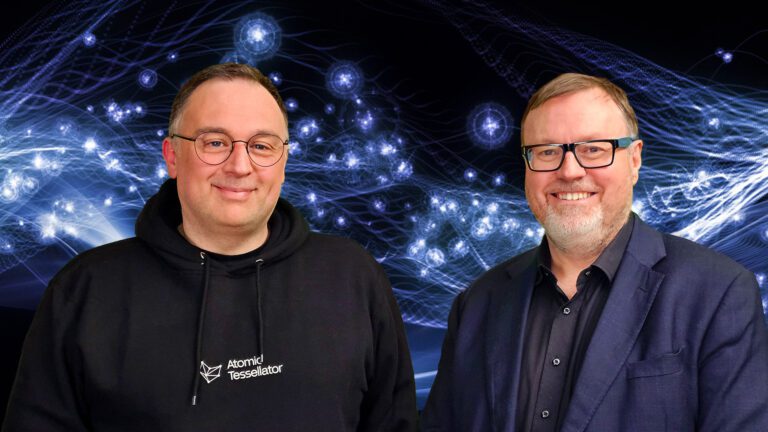
In this episode, host Paul Spain chats with Alain Richardt, founder of Atomic Tessellator. Learn about Alain’s unconventional journey from global tech consultancy to bootstrapping world-class innovation from his living room and discover how this Kiwi deep tech startup is using AI and physics-based simulation to design new materials at the atomic level before they are physically created.
Plus, the latest in tech news including:
Special thanks to our show partners: Fortinet, Workday, Spark New Zealand, One New Zealand, 2degrees, PwC New Zealand, and Gorilla Technology.
Read the full transcript
Transcript is computer-generated and may contain errors.
Paul Spain:
Greetings and welcome along to the New Zealand Tech Podcast. I’m your host, Paul Spain. Joining us today is Alain Rickard, founder of Auckland based Atomic Tessellator, a deep tech startup using artificial intelligence and physics to rethink material science by reinventing how new materials are discovered. With a background in large scale software and machine learning in New Zealand and the United Kingdom with companies such as Google, Alain has launched Atomic Tessellator in 2022 with the goal to tackle the hidden bottleneck behind modern technology, which is how we discover essential new materials. His team is building a digital lab that designs and simulates materials at an atomic level before they’re physically made, cutting development time in some cases from years to weeks. We with applications across energy, aerospace and advanced manufacturing. Welcome along.
Paul Spain:
Alain, how are you?
Alain Richardt:
Thank you, I’m good, thanks for having me.
Paul Spain:
Excellent. Well, before we jump in, a big thank you to our show partners to Spark, One New Zealand, 2degrees, Workday, Fortinet, PwC and Gorilla Technology. We’re super appreciative of their support not only of the New Zealand Tech Podcast, but of the broader tech and innovation ecosystems in New Zealand. Alain, maybe just a quick intro on, you know, a little bit about your background before we duck into the tech news and then dive deep into Atomic Tessellator.
Alain Richardt:
Cool. I’m a Kiwi, born here in New Zealand and then earlier in my twenties I went off to London. While I was in London, I spent 12 years there working at Google and DFP Systems and then also started my own deep learning consultancy while I was in London. We scaled deep learning technologies across a whole bunch of different backgrounds. So we were doing weather model prediction, energy prediction, real estate prediction, lidar processing, security systems, lots of different sort of domains. And then I came back to New Zealand just recently to be a bit closer to the family as well and also to take my skills and start to start to build a company that was in the materials and chemistry space. I had already. I had a really interesting teacher at high school who was like very supportive of my formative years and showing me chemistry.
Alain Richardt:
And that love sort of persisted throughout my career and has now led to Atomic Tessellator.
Paul Spain:
Brilliant. And I have to ask, but I saw in your LinkedIn what looked like some interesting use of AI when it comes to trading of crypto.
Alain Richardt:
Yes, yes, yes. For a couple of years I built a crypto arbitrage trading system and what that did was it looked at the defi exchanges, it looked for arbitrage trading opportunities and then basically calculated whether they were profitable or not and then made the trades. So I scaled that up. It was doing about 12,000 queries a second to figure out it would find profitable trades every few hours. And then I didn’t have a UI for it, so I found this thing called Open Mission Control by NASA. It’s open source GUI that they use to control the Mars rover. And I modified that to control the arbitrage trading bots and show the trading opportunities and then allow me to review them before I could submit them. So quite a varied background and all forms of AI.
Paul Spain:
Yeah, fantastic. How did that pan out for you? Was it a good use of your time?
Alain Richardt:
Yeah, I mean, at the time, that was after I spent my time in London. So after that I spent a couple of years as a traveling technomad across Europe.
Paul Spain:
Perfect.
Alain Richardt:
Yeah. And that was able to, I mean, it was generating around about 250,000 USD a year, which is not an enormous profit, but it’s enough. It’s basically a salary. So that was profitable for about. Generated that amount of money for about two years. And that allowed me to live across Spain, France, Germany and just to sort of travel a bit and do that travelling tech nomad type lifestyle.
Paul Spain:
Yeah, brilliant.
Alain Richardt:
Yeah.
Paul Spain:
Oh, that’s good stuff. Well, let’s jump into the tech news. First up, from a New Zealand perspective, we see that Minister David Seymour is urging Pharmac to use more artificial intelligence. He of course, is the Associate Health Minister and he’s really pushing Pharmac to expand its use of AI to speed medicine assessments, improve decision making and, you know, basically increase access to more medicines. And he’s really emphasising that human oversight, you know, is important, but arguing that smarter use of data could deliver faster, more equitable healthcare outcomes. You know, really that potential, you know, future role for AI in analysing, you know, medicine benefits and funding decisions. And yeah, not to replace the human element, but certainly to support it. So, yeah, that seems to make a lot of sense.
Paul Spain:
From a quick view on that encouragement, what are your thoughts on this side of things?
Alain Richardt:
Yeah, I think AI and healthcare is a super important thing that we should be focusing on. What I kind of see is there’s often a lot of focus on processing medical records or that sort of area, which is I think, probably the easiest for AI to service, but also the most boring. So recently there have been better developments in things like drug discovery. Midjourney medicine just released their own scanner that is able to do a full body MRI scan using sound waves. That dramatically lowers the cost of these sorts of things. And if you think of an MRI scanner, typically they’re kind of big machines that are bulky, they need specialisation to run, they need specialisation to interpret, they have to operate at very low temperatures because of the magnet inside them. So they’re just expensive. But it does usher in a new sort of era of health when all of a sudden an MRI costs $20 and you can get a full body scan every time you go and see the doctor.
Alain Richardt:
We’re going to catch diseases a lot sooner. And these are the kind of things that we want to lift us up as a species and not so much focus on the privacy aspect of handling these things with AI, although that is important. It’s not something really cool that the AI is going to give us that’s going to benefit everybody.
Paul Spain:
I agree. And look, there have been little opportunities along the way. Some of the opportunities for really leveraging AI and new approaches of, of reducing health problems or catching them early make a lot of sense. And obviously there’s a bunch of those companies in New Zealand as well and I was thinking around one of them recently, I think, oh, we need to do a bit of a revisit. So, yeah, it’s a timely story. Now also a story with the New Zealand angle. Rocket Lab have announced they will acquire Iridium, who, you know, many will know of as kind of the long term player in the satellite phone or satellite mobile market. You know, originally launched out of Motorola, you know, some decades ago, this is a deal worth around 14 billion New Zealand dollars.
Paul Spain:
But you know, what it’s likely to do is really help to transform Rocket Lab from the, the company that they have been into a company that is really very well rounded when we look at them as a space company. So many have thought of Rocket Lab as a launch provider. Of course, that’s actually been a minority of their revenue. Space systems aspect has been bigger. And this really creates that ongoing recurring revenue opportunity if they can, you know, really keep, I guess, shaping the Iridium business into something new. Because, you know, I don’t think there’d be too many people that have been, you know, lining up to buy new Iridium phones for, you know, for sure, for some time. They’ve been, you know, it’s been quite a niche, you know, product out there. You know, this gives, you know, Rocket Lab ownership of their existing, you know, global low earth orbit satellite network, but importantly also the spectrum that they’ve had.
Paul Spain:
And that’s not something I’ve sort of drilled into the detail on exactly how that looks. I think Spectrum when it comes to satellite communications has been quite an interesting area. For instance, when you look at the Starlink network to date with providing Internet access, SpaceX have been able to do that without generally acquiring spectrum because there’s been spectrum specifically tagged for satellite commun in the past. Hence why we’ve seen SpaceX have such fast success when it comes to that satellite Internet. But yeah, this also marks quite a key shift for Rocket Lab and puts Rocket Lab in a very, very strong position with building, launching and now operating infrastructure in space. So very much makes them that sort of vertically integrated player which is what so many people have been excited about from SpaceX is just that full broad capability.
Alain Richardt:
Yeah. And we think Rocket Lab is really inspiring. We share an investor and we look up at them and see a New Zealand company who competes up there globally with the best of them. And yeah, the acquisition of this is just, is just a great because it’s a multiplier on their abilities. And we’re starting to see we’ve got investors that are very bullish on all aspects of space. Not just space communications, but also space manufacturing and all of these sorts of things. And all of them. I was giving a talk at the Resilience Conference a couple of weeks ago and I spoke to many space companies there and they talked about, you know, the temperature variation of materials in space is so much greater when you’re on Earth.
Alain Richardt:
You’re kind of like minus 20 to plus 50 are kind of your extremes. And when you’re in space you’re, you know, nearly negative, negative 200 and then all the way up at 400 in the sun. And that, that has a lot more materials challenges than the normal Earth based stuff. So it’s interesting that, you know, as manufacturing capability goes up in space, there’s going to be greater materials challenges and kind of we’re on the forefront of researching that as well for high thermal conductivity, getting rid of heat, you know, these sorts of things. So yeah, very excited about Rocket Lab and they’re a great inspiration for us as an awesome New Zealand company.
Paul Spain:
Yeah. And I think, you know, looking at, you know, this is just, you know, one more, you know, step forward from Rocket Lab. But you know, it seems like, you know, Peter Beck and the team are very, very much a forward looking company and there will be, I’m sure, lots more surprises in the months and years ahead of things that many wouldn’t have predicted for Rocket Lab. Of course, the reality that Rocket Lab have grown in terms of their valuation, you know, particularly over the Last sort of 12, 18 months, makes this sort of thing a whole lot easier for Rocket Lab to be able to do these sorts of acquisitions. But it seems very likely that this won’t be the last acquisition. This seems to now have become a really key part of Rocket Lab’s playbook and they can really benefit, you know, I think, you know, their sort of size and scale, you know, will benefit from this from a recurring revenue perspective and you know, Iridium as a, you know, as an existing, you know, becoming on board as a business unit then can obviously leverage, you know, all of the capabilities within Rocket Lab as they, you know, probably rethink what their future looks like.
Alain Richardt:
Yeah, yeah, broadening that capability is really exciting.
Paul Spain:
Yeah. And then going on to the global front, we’ve heard that, you know, SpaceX reported to be considering a direct consumer Starlink mobile service. So this sort of thing has often been bounced around as, look, the end of mobile carriers is coming because of low Earth orbit satellites being able to provide connectivity. I certainly haven’t seen evidence that’s, you know, a really, a direct likelihood. However, this, this indication, you know, points to SpaceX, you know, potentially being able to compete with major carriers in the, in the US market. But, you know, likely that would mean for them to be able to do that, that they would need to, you know, build a terrestrial network as, as well it seems, you know, very unlikely they can, you know, they can compete, you know, directly with existing carriers without the same or a similar level of infrastructure, you know, on the ground. And yeah, it’s going to be kind of fascinating to see, you know, what this actually looks like. We know they’ve acquired a chunk of, you know, Spectrum, you know, previously, but there are lots of pieces that would need to come together for this to, for this to play out.
Paul Spain:
But I think, you know, we’ll all be watching with interest and you know, knowing that Rocket Lab, you know, are also, you know, now now in that, in that game. Yeah, in that game, you know, I think, you know, we’ve got a fascinating, you know, period of, of history ahead of us. So yeah, yeah, yeah, I think sort
Alain Richardt:
of broadly more, more competition is, is good because, you know, there’s, there have Been a lot of things that potentially holding back innovation in terms of mobile data rates and things like that. So we’re kind of entering the more connected world now and everything needs to have kind of a SIM card in it so that it can talk. And I’ve worked for companies in the past, for example that they were doing generators, wind generators, smaller scale ones that could be put all over the country and by the time you’ve got 200 of those, every single one of them needs to have a SIM card in it and that they should all be uploading data to the mothership. You know you need to be able to have data needs to be 10 times or 100 times cheaper. So hopefully we can move towards that, that world where it’s easier to hyper connect things.
Paul Spain:
Yeah, yeah, yeah, it’s a very, very, very fascinating time in terms of how these, how these things, yeah, playing out just on a quick look. Yeah, it looks like Iridium own and operate a chunk of L band spectrum in the 1.6 GHz range. So yeah, this is all part of the picture but it sounds like you know, 9 megahertz which is useful and it penetrates, you know, weather and vegetation pretty well. So you know, quite a highly sought after asset. And yeah, kind of curious how this, how this would play out for yeah, more modern services and capabilities in the future, you know, whether they would cross into sort of competing with the likes of as Space Mobile who you know, contracted in New Zealand with two degrees to provide their, you know, mobile to satellite services. So yeah, interesting time ahead and no doubt we will, we’ll hear more in the future. Now onto other topics. A global operation led by law enforcement and tech firms has disrupted a cybercrime assembly line by targeting malware platforms Amadi and Steelsea.
Paul Spain:
The crackdown has led to the seizure of infrastructure, recovered millions of stolen credentials and cut off tools that are used widely in ransomware and fraud operations. Some 27 million stolen credentials recovered. Always encouraging to see this sort of disruption to the, you know, world of cyber criminals. There’s, you know, there’s always so much going on behind the scenes that, you know, causes significant damage but it does seem to be that sort of cat and mouse game. And you know, at times we see, you know, these sort of positive disruptions. At other times, you know, the sort of cybercriminals tend to make significant progress without getting well challenged.
Alain Richardt:
Yeah, I think it’s good because it is an arms race and the odds are in the favour of the attacker in cyber. Right. Like the attacker only has to find one chink in the armour. Right. So it’s nice to hear the positive aspects of it. More broadly speaking. If you look over the last couple of months, you’ll see in the cybersecurity with the rise of AI tools and automatically finding exploits and things like that, there have been large, large increased numbers and bug reports to the open source projects and things like that, where all these. There’s almost an era where all of this human engineered code will be machine reviewed and then everything will kind of stabilize at some point or at least those bug reports will go back down again.
Alain Richardt:
And we’re right in the middle of that now. Right. Like vulnerabilities are coming out faster than they ever have and patches are coming in faster than they ever have. And had a similar experience. We were audited by a programmatic cybersecurity company and I sort of have a bit of a background. I was in cybersecurity for a couple of years and I know what a small and talented team can produce and I know what then I was able to compare that and contrast that to what the machines could produce 10 times cheaper and 100 times faster. And really it was amazing to see the quality of a machine audit and then to have machines also fix that and then humans to obviously review it. But it’s nice to see that the positive aspect of this in the news as well, that the shields are up and the machines can defend us as well as they can attack.
Paul Spain:
Yes, yes. And then the other couple of stories I wanted to touch in on. One, Apple’s price hikes due to memory costs is what they’ve said. So yeah, this has increased prices across Macs and iPads and very much driven by AI demands on memory especially and related supply chain constraints. So this has seen for instance, the base MacBook Air in the New Zealand market was 2,200 New Zealand dollars. That’s jumped to I think 2,600 New Zealand dollars. So we’re sort of 15 plus percent jump in prices and obviously this varies across there their product range. If we look at Microsoft, who have got their Surface products which somewhat align with the MacBook in terms of being a Windows kind of compete with the MacBook products, we’ve seen huge jumps on that side as well.
Paul Spain:
And I mean some of those numbers have been somewhat eye watering. I think one case it’s a 50% increase from the prior model to the current model in terms of prices. So yeah, quite a big impact. That said, I think if you look back over the last 30 years and we look at the value and what we’ve got for our money when it comes to hardware prices have effectively, once you consider inflation, have kept tracking down and tracking down and tracking down. So it’s not quite the end, end of the world, but it is going to be going to be painful for individuals, families and for organisations who are maybe having to stump up quite a lot more for hardware purchases. And this could well flow on into the cloud services and so on that we’re used to paying for. That said, I think we’ve seen say, increases in or improved value when it comes to say, storage over a period of years that probably hasn’t been passed on by a lot of cloud vendors, be it AWS or Microsoft. We haven’t seen their prices for cloud storage particularly tracking down.
Paul Spain:
So I would argue that they owe us something on that front. But they would argue they want to keep lining the pockets of their shareholders with more and more profits.
Alain Richardt:
Yeah. Yes. Yeah. I do hope to see a jump down in price when the supply shores up again. But yeah, maybe that might be too optimistic. But also the other thing is that we see this in critical materials too. We’re getting signals from intelligence partners and things like that that show sudden extreme spikes due to scarcity and supply chain interruptions. So there was a rare earth that that’s price jumped 4,000% just recently.
Alain Richardt:
A few months ago there was another one that was 2,000%. And we actually have a list going forward of projected demand across EU and we model all of that internally because it matters to guide what we should study next and the rare earths we should find replacements for. And we know, for example, and this is not a stock tip, but we do know that there is a great increase in the projected demand for iridium in the EU in the next couple of years. They’re projected to just. The EU alone will consume 120% of the global supply of Iridium. So there’s going to be a shortfall of that coming up. And as a result we target materials that can replace that. And so this all feeds into the.
Alain Richardt:
You’re talking about Iridium as the material. As the material.
Paul Spain:
Nothing to do with the.
Alain Richardt:
Yeah, yep. It’s kind of annoying that these things flow down into the consumer devices as well.
Paul Spain:
Yes.
Alain Richardt:
So, yeah, I hope that that’s just an ultimate system that, an ultimate symptom that we can get rid of at the supply chain level by shoring that up a bit.
Paul Spain:
And then the last story is anthropic have alleged that Alibaba conducted a massive distillation attack on them using I think 25,000, you know, fake accounts and millions of interactions to try and extract and copy Claude’s AI capabilities. You know, this is something that we’ve heard, you know, in recent times about these distillation attacks, you know, particularly from China and the claims. Yeah, really highlighting, you know, growing geopolitical tensions, you know, risk to the cutting edge IP from these models and that desire to replicate advanced AI systems as quickly as possible. And the US has been very much sitting at the forefront here. But if a distillation attack can allow open source and other models to be able to replicate those models, then that’s part of how we see the open source models maybe sitting, you know, not too far behind the latest frontier models.
Alain Richardt:
Yeah, it’s a real shame that that kind of attack exists because it’s kind of, you know, it really is in a fundamental way a theft. But I do also want to encourage sort of the decentralisation of AI for everybody because there is quite a dark future and a central single company owning all of humanity’s intelligence abilities. We’re already starting to see in the higher universities that the rates of math cheating and things like that are getting very high as the younger generation is outsourcing their intelligence to a private company and having that all centralized in one place. I’m not sure that’s a great idea for 10 years in the future of humanity. But open source AI is kind of the source of democratizing that for everybody. And we do want everybody to have a scientist in their house or, you know, when I was very young, I fished computers out of the trash and that was my first sort of as a 12 year old, building a cluster in my room and that sort of thing. And we want the next generation to have the equivalent of that. They should have a little AI in their bedroom that they can play with that’s close to the frontier models and
Paul Spain:
something there to keep the bedroom warm.
Alain Richardt:
Exactly.
Paul Spain:
And provide some intellect. Yeah, yeah, very good. Well, let’s jump into, you know, to hear from you, Alain, around Atomic Tessellator, maybe, you know, more of the background story. We’ve heard a little bit about your background, but yeah, very, very keen to see how you brought your initial ideas together and got things off the ground. Because it’s been moving very, very quickly from what I can see, and you’ve raised some significant funds there, so maybe you can walk us through a little bit of that.
Alain Richardt:
Yep, sure.
Paul Spain:
Yeah.
Alain Richardt:
Well, I’ve always been a bit unconventional in my approach. To sort of life. And Atomic Tessellator had a bit of an unconventional start as a company as well. So I built the very first version of it as a hobby project while I was working for a US company. And the advantage of working remotely was that I could start work at 3am and I would be finished by 10am and then I would just rest for an hour and I had all afternoon to work on passion projects. I spent the first kind of six months, all of the afternoons building Atomic Tessellator to study surface catalysis, because that was just an area of physics I was interested in. And then what happened is I entered it in a data streaming competition and won 250,000 USD.
Paul Spain:
Wow.
Alain Richardt:
And that kick started the company. So it was like, okay, we’ve got enough money now to work on this full time. And then we were at the same time I entered it in the Amazon accelerator program and went to pitch at the end of that. And then we were noticed by two other investors and at the same we sort of brought up to a million USD as a pre seed raise. And then the company turned into from hobby project to real thing. So that was about a year and nearly a year and a half ago. And then since then we’ve been building out our simulation capability to simulate metals, alloys, rare earths, magnets, these sorts of things. And then we had anticipated it would take like two or three years to come up with a new material.
Alain Richardt:
It actually happened a lot faster than that. So we made our first novel materials discovery about seven months after that initial funding period. We put it through the labs. There’s been a few iterations backwards and forwards of that. So it was synthesized in reality, not just sort of made in a computer.
Paul Spain:
Fantastic. Maybe you can, in your words, kind of break down what you do at anatomic, you know, test later in a little bit more detail.
Alain Richardt:
Yeah, sure. So we’ve built a virtual material lab. So what that means is that we can take some material or some desirable properties and say, okay, within a whole bunch of these constraints, come up with a new material that satisfies everything that we want. So a concrete example of it is say samarium cobalt. And samarium’s cobalt is a high temperature magnet and it’s really supply chain constrained because samarium only comes from one country. Who would need samarium? It’s used in lots of places in defence. So in the F35 fighter there’s 20 kilos of it in each fighter. It’s used in high temperature actuators, robotic actuators, Generators, electric motors, all of these places.
Alain Richardt:
So it’s basically, it’s a magnet that can survive high temperatures. But the problem is it’s a rare earth magnet. So it’s really supply chain constrained. What our software platform can do is it zooms right down to the atomic level. And we say, okay, in this little virtual chunk of samarium cobalt, what makes that thing special? Like, everybody, when they talk about rare earths, they’re like, how can we make a rare earth mine? We actually went back to the fundamental question, like, why do we need this rare earth? Like, what’s special about that thing at the atomic level? And then at that atomic level, we generate this really high resolution fingerprint. And it’s a million voxels, it’s super high resolution. And we’ve got a database of 115 million materials, all different atomic interactions. And we say to our system, find us something that behaves like samarium, but doesn’t have that rare earth in it.
Alain Richardt:
And then we do a whole bunch of downstream simulations, grip and pull, perturbation theory, thermals, all of these things to make sure that it behaves well in the real world. And when it does, we send it off to the lab to be made. And that way we can say, okay, why do we need this rare earth and how can we get rid of it? Or how can we replace it with materials that we have domestically?
Paul Spain:
And you know, how successful, you know, is that? You know, it can look very good in a, you know, in a simulation.
Alain Richardt:
Yes.
Paul Spain:
But, you know, once it comes to, you know, actual production, you know, what have you learned on that front?
Alain Richardt:
Yeah, that is really core. Because a lot of simulation companies, they basically model theoretical materials that like, they have no defects in them, they don’t take into account temperature effects. All of these, they sort of model this idealised system that works at zero Kelvin. And it’s too theoretical. And even very big companies, I won’t name them, but even very big companies do this method, right? And it turns out that the things that they produce are worthless because they don’t consider all the real world things. So part of what we spent a good six months, sort of eight months building internally, and we’re still building now, is all of these downstream simulation capabilities that say, okay, how does this behave in the real world? What’s its corrosion profile, what’s its thermal profile, you know, how does it react for shear strength and all of these downstream effects? And because we’re able to build all of these different workflows out, we’ve had 10 different materials made in the lab and eight of them have been the equivalent or better than predicted materials and only two of them have failed, which is much, much higher than traditional rates. But that’s because we’re able to do a lot more in the simulation world.
Paul Spain:
That’s incredible. I mean, that speaks very, very well to what actually is going on in terms of your computer based simulations.
Alain Richardt:
Yes, yeah, yeah. And one of the interesting things, sort of stepping back and like if you look at tech as a whole, you say, where are the interesting things happen? And the interesting things happen right at the edge of what the computers can do. Right. So if you go back to 1999 and say, I’m going to start YouTube and we’re going to encode every video that gets uploaded, people would say, oh, you’re crazy, you don’t have enough computing power to do that. Right. But right at that time, if you’ve got a whole bunch of computers in a rack and force them, you kind of could do that. Right. And we’re the same.
Alain Richardt:
So we’ve got, you know, we’re down in my house, I’ve got a big cluster in my living room that’s loud and noisy and my electricity bill is five times the national average. Right. But it’s got 15 GPUs in it and it pushes right at the edge of what these machines can do. And that’s where all the exciting bits happen.
Paul Spain:
Wow. Wow. Now, I mean, that to me probably raises some, you know, triggers in terms of how you protect your IP and how you lock those down like Fort Knox. There was another topic we didn’t have time to delve into on memory encryption. There’s probably all sorts of aspects there, but yeah, we probably don’t want to push you too hard on those aspects.
Alain Richardt:
No, that’s okay. I mean, it’s a valid point. It’s interesting because when we started off, we had raised a million USD, but the amount of computing power that we required to make these discoveries would have cost 50,000amonth in cloud computing power to do it. But we were able to build the system in my house for about 30, 40. So the system paid for itself in a month really quickly. But you do have, obviously the problem of this is in some dude’s house and it’s like the very first version of Google you’ve seen. It’s a couple of computers in a garage. That’s true.
Alain Richardt:
But now that we have actually done another raise just recently, a few months ago, and we’ve migrated all of the IP stuff out of my House now. So we’re a real company and we’re okay on that front. We’ve de risked from there.
Paul Spain:
I was sweating a little bit there. I was like, we let the cat out of the bag on something. So I’m kind of curious to hear, in parallel to the research that you’ve been doing, part of the startup journey is raising capital. Sometimes easier said than, in most cases, easier said than done, to be fair. But what can you share about your journey on that front? How much you’ve raised and valuations and so on today? Sure, yeah.
Alain Richardt:
So we did our, our first raise was about a year and a half ago. It was a million USD pre seed. And that was one of the things that I’m really appreciative of of our initial investors because deep tech companies are capital intensive and they’re risky. So, you know, they were very early believers in us and they returned to participate in our next round as well. But we also got on some really great New Zealand investors and some US investors as well. But our most recent raise, we raised 13 million New Zealand dollars at a 50 million valuation. And sometimes, I mean, just speaking to all the other startup founders out there, one of the things that I would encourage them to do is maintain a relationship with all of the investors all the time through. So ever since, even when we finished raising our pre seed amount, I would email all of the investors that I would talk to first.
Alain Richardt:
I would ask their permission, can I put you on our call list?
Paul Spain:
Sure.
Alain Richardt:
And then I would email them every one or two months. And not a big waffly thing. It’s one screenshot and a few sentences. Hey, we did this really cool thing and it would be, we made this new metal, we shipped this new feature. One screenshot. And then by the time it came to raise our pre seed amount, we were 2.5 times over subscribed in two weeks. Right. And everybody kind of hears that two weeks part of it and goes, oh, wow, money came to you so easy.
Alain Richardt:
But actually you’ve got that year of relationship building that’s so important. They already know who we are when it’s time to raise. So yeah, I would encourage other founders to maintain those networks all the time.
Paul Spain:
Yeah, that’s great advice. And how have you sort of balanced the workload? Because as a company you’re pretty lean and mean in terms of, you know, the size of your team, people wise. But of course you’ve been, you know, very much a company of the AI generation. So how have you done that?
Alain Richardt:
Yeah, yeah, it’s Been really interesting. We’re very bullish on AI as a whole. So we have adopted it. We have very early adopters in the technology. A lot of our company is automated, so all of our finances automated, all of those underlying parts of the completely automated, but with a lot of balances and checks in the play. But it’s interesting because there are, you know, VC companies and other companies that maintain statistics of the amount raised versus the number of people that you have. And I think Atomic Tessellator is one of the companies that has the smallest number of people with a larger amount raised because of the level of automation that we’ve got. So when we raised, when we completed our raise recent one of 13 million, we only had a staff of four, myself included.
Alain Richardt:
But even still, I mean, it takes a lot of time to build the right culture. Like we’re a remote company and remote companies are prone to isolation when people, they’re not that connected. So you have to get the right type of personality for those types of people. And you also have to hire people that are very autonomous. And mostly my job as the founder is to find an awesome person and then get all the roadblocks out of their way. So I spend all my time just getting roadblocks out of the way, supporting the team and letting them just be the best version of themselves. And when you give that trust to the people, it’s like one of the things that I’m proud of at our company is that we don’t have start times, right? Like, I don’t care if you come in wandering at 11 o’ clock with a coffee. If you wanted to sleep in, sleep in.
Alain Richardt:
Because we’re based on merit and you have that level of trust. And if you find that you’ve given that trust to somebody that you can’t, you’ve made a wrong hire. Right. So yeah, we’ve got a really close knit team and that’s enabled us to embrace AI in terms of automating all the underlying stuff and then act kind of like a team of 30 with just four.
Paul Spain:
Wow.
Alain Richardt:
Wow.
Paul Spain:
Yeah, that’s very impressive. And what are your views? Because some listeners will hear that and we’ve heard lots of things in the media around the impact of AI
Alain Richardt:
on
Paul Spain:
the workforce, on future jobs and so on. What’s your take as yours? Are you positive in terms of how these things play out or are you concerned that we wipe out half the workforce and have people sitting around doing nothing?
Alain Richardt:
Yeah, that is a valid concern, but I think it doesn’t sort of. It’s really just a fear of the unknown of what’s coming and we will all, as a society will adopt to it. I do think I am kind of liberal in my views of the world and I do think that the benefits of AI can’t just go to a top few percent of people. Every time there’s a productivity increase in a company, the benefit seems to flow to the top and everybody still works hard. Right. So I’m a big believer that everybody should benefit. So maybe we shouldn’t be working 40 hours a week. Maybe we can wind that back a bit and everybody in the world should benefit.
Alain Richardt:
But there are crazy people like myself that are always going to work seven days a week. Right. Like we just, we do it for love. Right. But that doesn’t. But it should be a choice. Right. Of the people who want to do that.
Alain Richardt:
And I was talking with our lab partners this morning and they were also worried about, you know, AI taking their job because in an idealized world, a simulation materials platform wouldn’t need a lab to then go and do the. The parts of it. But I don’t see it that way at all. As we’ve expanded our modelling capabilities, there’s just more things we want to study. So actually we need more labs. So my answer to them was AI is not going to take your job. You guys should be embracing AI and 10xing what you need because we need that downstream.
Paul Spain:
Yeah, that’s encouraging. I think I would lean in a similar direction and be very hopeful that, that, you know, as a society, you know, we really do manage to overall get a good uplift without, you know, too many crazy, you know, predicted side effects. But that is something that, you know, we’re going to have to navigate and there’ll be no doubt some hard decisions along the way in that journey and a lot of change. Right?
Alain Richardt:
Yes.
Paul Spain:
That’s kind of the era that we’re in.
Alain Richardt:
Yeah, yeah, yeah.
Paul Spain:
So maybe you can share with us another new material example you’re either you’re focused on or you might be in the future.
Alain Richardt:
Yep, sure. So the first new materials that we made was a high temperature magnet, which is the replacement for samarium. But what happened shortly after that discovery is that we were given a challenge by a fairly senior US entity and they had a concern around a material called tantalum. And tantalum is mined only in Central Africa and the US has a. They need it for hypersonic rockets and high temperature shields. And it’s used in tantalum carbide, which is just a high Temperature metal. But their supply is unreliable and you know, it’s prone to interruptions because of changes in government and things like that. So they said, can you get us, can you read this report on tantalum and come back to us in a week and tell us what you think of it? So they gave us this report.
Alain Richardt:
What we did was we pulled the report into our platform. We scaled up to 200 GPUs. We computed for five days non stop looking for an alternative. And then we found an alternative that has no tantalum in it, but actually performs better mechanically than that one. So it was a rare earth replacement material that doesn’t need the rare earth and performs better. And then we went back to this entity and said, hey, we didn’t just read the report, here’s a replacement material and we’ve sent it to the lab for synthesis in one week. Right. And then that entity invested.
Alain Richardt:
Right. So yeah, and that’s one of the cases where, you know, materials discovery is like five years, 10 years normally, but we’re able to pull it down to just a week.
Paul Spain:
And so how do you make this work, you know, successfully, you know, for those organisations that you’re serving and commercially for Atomic Tessellator? I mean, it sounds like there’s some, there’s some good room in there for this to work commercially.
Alain Richardt:
Yeah. Yes. So we did some. Because this is such a new thing, you kind of experiment with different commercial models all the time. So last year we started doing some software as a service. We started doing consulting that was super cool. We did plasma facing components inside fusion reactors for a U.S. fusion company.
Alain Richardt:
We modelled aerogels for a company that was making aerogels for the Department of Defence. Like all these kind of really cool projects. But even still, we were inventing the material or inventing enormous leaps in capabilities, but we weren’t capturing the value of what we were doing. So one of the things that we. And then at that same time, while we were doing that kind of SaaS model, we started making our own materials discovery. And at that point it was like, okay, do you plod along getting a couple of hundred thousand dollars a year from SaaS licenses or do you scale up the material yourself and get that uplift? So that’s why we raised the larger amount to actually go along that materials angle and scale up. And recently we’ve been in talks with very senior levels of Australian government, even just last week, talking about what it would take to scale that kind of thing up. And although the numbers might sound scary to some Smaller kind of investors actually the, the asks for scaling this technology up one tenth of what is already being allocated to just stockpiling rare earths and things like that.
Alain Richardt:
When we’re talking about a commercially viable alternative with for one tenth the money that also creates jobs and employment and captures all the value. So it’s quite a compelling offer compared to just stockpiling these materials.
Paul Spain:
Yes. Was this very much a pivot or did you have this thinking in mind from the get go as the likely direction you’d take?
Alain Richardt:
We did have this in mind but we had planned it for much later. We did think that sort of it was going to be post series A and downstream once we have the materials validated and those sorts of things. But after a. At first it was really hard to find a lab that was able to make all of these crazy materials. They didn’t have the right equipment and things. We searched around globally and went through 38 different labs until we found one that has only 60% of the equipment we need, but it’s good enough to do it. So yeah, we’ve just started a partnership with them and they’re doing really well and we gave them the base materials to do. But we’ve also given them some really wild, what are called high entropy alloys to do and they’re fairly far along the synthesis capability of that.
Alain Richardt:
And these are new materials that, that haven’t really been commercialized by anybody globally. So we try and balance how much of your attention should go into exploiting the thing that you know is viable versus exploring new opportunities. Right. And when you’re, and when you’re training machine learning models, even doing that kind of thing, you balance the injection of entropy which is the explore versus exploit what you know. So about 80% of our efforts go into exploiting what we have already discovered and know. And then 20% of the efforts go into crazy moonshot type ideas on the long odds that they will pay off. But those odds are not really lottery, they’re actually starting to pay off. Wow.
Paul Spain:
So if you were to sort of look at the longer term in terms of where you could be in a decade, a decade or two’s time, and noting that there will no doubt be other competition around the world, what do you imagine that could look like?
Alain Richardt:
Yes. Yeah, we’ll have an office just beside Rocket Lab and be their brother. But, but yeah, there is, I think one of the important things to look at is kind of the trajectory. So there are, There are about 15 material science companies in the world. I had, I was sort of proud, in a contrarian way, that we were the lowest one a year ago. We had. We’re the smallest team, we had raised the least. Super scrappy, super.
Alain Richardt:
A little bit contrarian, a little bit wild, but kind of dreaming big like every New Zealand company should be doing. And then a year later, we’re kind of number five in the world. And that’s just in one year. Some of these other sort of competing companies are 10, 15 years old. And it’s the trajectory which has also helped us get noticed by high levels in the US and Europe and Australia as well. Yeah.
Paul Spain:
Oh, that’s incredibly exciting. Yeah, thank you very much. Was there anything else you wanted to add before we finish up the episode?
Alain Richardt:
Yeah, sure. If anybody wants to find out about us, there’s atomictesellator.com, follow us on LinkedIn as well. We’re also always looking for really great talent, so, yeah, please come to us. And I try and sort of be a member of Python New Zealand and these other kind of community events. And I also mentor young programmers who are early in their career. So if anybody wants some kind of guidance or advice or things, I always try and help if I can.
Paul Spain:
That’s excellent. That’s fantastic. Well, thank you. Thanks so much for being generous with your time and your insight to Lane.
Alain Richardt:
It’s great.
Paul Spain:
It’s brilliant. Yeah. Thanks everyone for listening in. And of course, a huge thank you to our show partners, to PwC, Fortinet, Workday One NZ, 2degrees, Spark and Gorilla Technology really appreciate what they do to ensure that we’re able to keep publishing throughout the years. And look, if you’ve been watching our video, then make sure you’re following on your favourite podcast or audio platform. And of course, if you’ve been listening to the audio, which is most of our audience, great. If you can also follow us on the likes of YouTube so you can access our videos as well. Well, that’s us for this week and yep, we’ll be back again with another episode next week.
Paul Spain:
And if you haven’t been catching up with the latest New Zealand business podcast episodes, worthwhile jumping across there. Some really fascinating interviews over recent weeks and a lot more to come there too. All right, take care. Thanks, Alain. Cheers.